

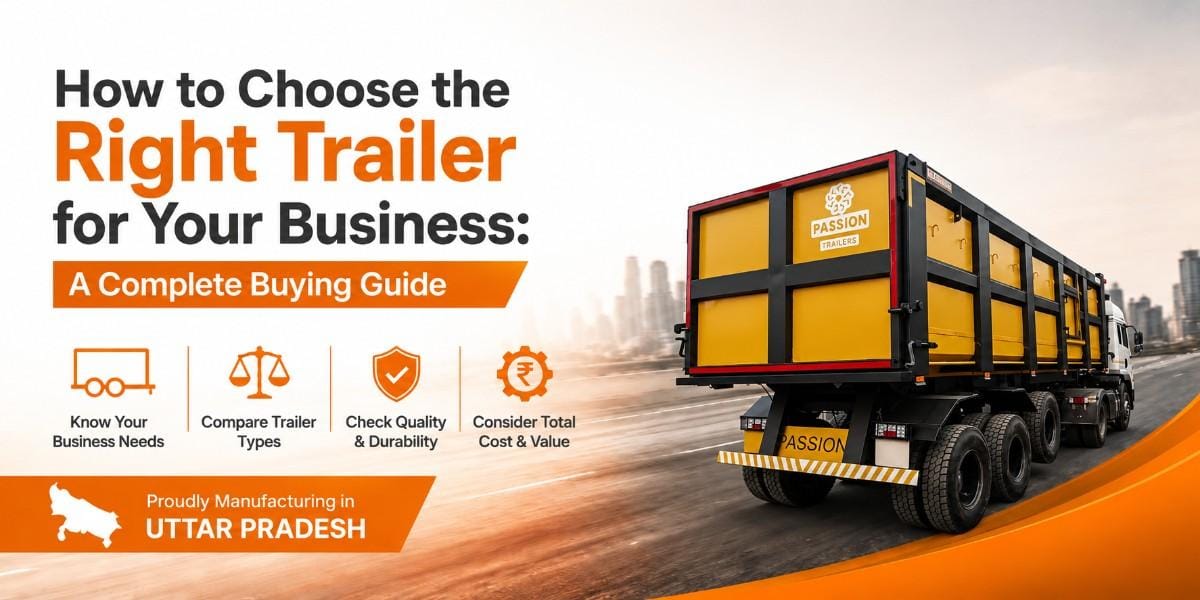
Start With If you’ve never bought a heavy-duty trailer before, the sheer number of options can feel overwhelming. Flatbed, container, low bed, side wall, skeletal — every manufacturer’s website lists half a dozen configurations, and most of them don’t explain which one actually fits your business. This guide is meant to fix that. No sales pitch, just a straightforward walk-through of what to actually consider before you buy.
What You’re Actually Hauling
This sounds obvious, but it’s the single most common mistake buyers make choosing a trailer based on price or availability rather than the cargo itself. The shape, weight, and handling requirements of your typical load should be the very first filter you apply.
If you’re regularly moving construction equipment, industrial machinery, or oversized materials that don’t need weather protection, a flatbed trailer is usually the right starting point. Its open, level bed makes loading and unloading straightforward, especially with cranes or forklifts, and it handles irregular shapes far better than an enclosed option.
If your business runs on containerised freight moving standard shipping containers between ports, depots, and warehouses you don’t want a flatbed. You want a container trailer, built specifically to lock a container securely in place and handle the repetitive loading cycles that come with that kind of logistics work.
And if height clearance is a recurring headache say you’re transporting tall machinery under bridges or through low-clearance routes a low bed trailer solves that problem by sitting closer to the ground, effectively giving you more usable height for the cargo itself.
Think About Load Weight, Not Just Load Size
A trailer that looks big enough on paper can still be the wrong choice if it’s not rated for your actual payload. This is where a lot of buyers get caught out later, once the trailer is already in use.
Every trailer has a rated capacity, and that number should account for your heaviest realistic load, not your average one. If your business occasionally moves something significantly heavier than usual a seasonal spike, an oversized one-off job, it’s worth sizing up rather than assuming you’ll simply avoid those jobs. A trailer that’s underbuilt for its workload wears out faster, and the frame stress shows up in ways that are expensive to fix later: cracked welds, suspension issues, and steering problems that didn’t exist in the first few months.
Match the Trailer to Your Industry, Not Just Your Cargo
Two businesses can transport almost identical-looking loads and still need very different trailers, simply because of how their industry uses them.
Construction and infrastructure work usually means repeated loading and unloading of heavy machinery, often on rough, unfinished terrain. That calls for a trailer with a reinforced frame that can handle constant stress without fatiguing early.
Mining operations are even harder on equipment constant vibration, abrasive material, and near-continuous usage cycles. If your trailer isn’t built with that level of durability in mind, you’ll be looking at far more frequent repairs than a mining operation can realistically absorb.
FMCG and agricultural businesses often need a different kind of protection altogether less about raw structural toughness, more about shielding goods from weather and road debris during transit. That’s usually where a side wall trailer or container trailer makes more sense than an open flatbed.
If you’re not sure which category your business falls into, it’s worth actually asking the manufacturer this directly. A trailer built primarily for construction sites is not automatically the right fit for agricultural transport, even if the payload numbers look similar on a spec sheet.
Check the Build Trailer Quality, Not Just the Price Tag
It’s tempting to compare trailers purely on upfront cost, but that number tells you very little about what you’ll actually spend over the trailer’s working life. A few things are worth checking specifically:
The steel grade and frame thickness used in construction directly affects how much payload the trailer can handle without adding unnecessary weight which in turn affects your fuel costs and tyre wear over time.
The braking system matters more than most buyers realise. Trailers that adjust braking pressure based on whether they’re loaded or empty perform more consistently and put less strain on components, which becomes especially noticeable on longer routes or hilly terrain.
Safety compliance isn’t optional, but it’s also not uniform across every manufacturer. Look for CMVR-compliant under-run guards and proper certification ICAT, IATF, or ISO, depending on what’s relevant to your use case rather than taking a trailer manufacturer’s word for it.
Corrosion resistance is easy to overlook until a couple of monsoons in, when a poorly treated frame starts showing rust in places that are expensive to repair. Ask specifically about the shot-blasting and painting process used, and whether it’s been tested against salt-spray corrosion standards.
Don’t Underestimate After-Sales Support
This is the part of trailer buying that gets the least attention upfront and causes the most regret later. A trailer breaking down mid-route isn’t just an inconvenience, every hour of downtime is a direct cost to your business, whether that’s a missed delivery window or idle equipment on a job site.
Before buying, it’s worth asking a trailer manufacturer some direct questions: Do they have a service network beyond just the point of sale? How quickly can they respond if something goes wrong on a route far from their base? Are spare parts readily available, or do you end up waiting weeks for a specific component?
A Trailer manufacturer that can answer these clearly, and back it up with an actual service network rather than just a sales promise, tends to be a far safer long-term bet than one offering a slightly lower price with no real support structure behind it.
A Quick Way to Narrow Down Your Options
If you’re still unsure where to start, it helps to answer these questions honestly before contacting any manufacturer:
What does your heaviest, most demanding load actually look like not your average one? What industry are you operating in, and does your trailer need to survive rough terrain, constant vibration, or weather exposure? Do you need height clearance, weather protection, or open-bed flexibility more than anything else? And realistically, how quickly do you need support if something breaks down mid-route?
Once you have honest answers to those four questions, most manufacturers should be able to point you toward the right configuration fairly quickly and if they can’t, that’s usually a sign to look elsewhere.
Making the Final Call
Choosing the best trailer manufacturers isn’t about finding the cheapest option or the most popular one it’s about matching the build to your actual operations. A construction business moving heavy machinery between sites has fundamentally different needs than a logistics company running fixed container routes, and no single trailer configuration works well for both.
Take the time to be specific about your cargo, your industry’s working conditions, and what after-sales support actually looks like before you commit. It’s a decision that affects your operations for years, not months, and getting it right the first time is almost always cheaper than fixing it later.
If you’re weighing your options and want to talk through which configuration fits your business, reach out and we’ll walk you through it based on what you’re actually hauling — not just what’s on the price list.